Skillset Blog
AI Skills vs Online Courses: Which One Changes Your Output
Courses move knowledge into your head. AI skills move a procedure into your tools. Where each one wins, what each costs, and how to choose.
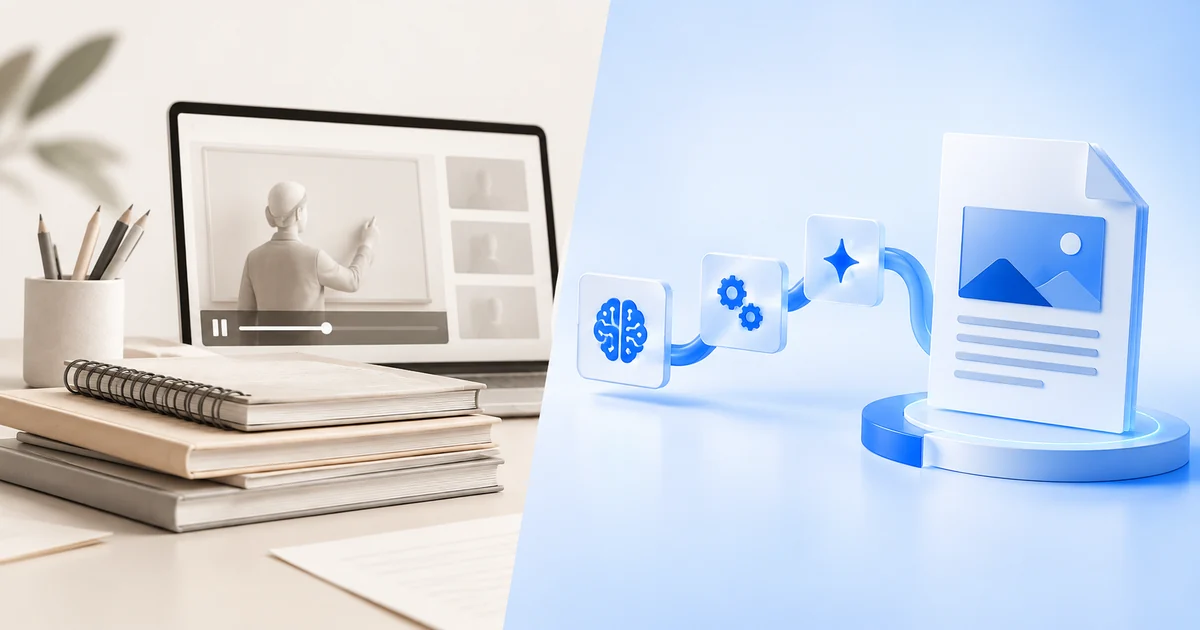
A course teaches you a process. An AI skill runs one. That difference sounds small until you count what happens after the purchase: a course leaves the work with you, and a skill leaves the work with your assistant. Both can be worth the money. They are worth it for different reasons, and buying the wrong one is how people end up with 40 hours of video and the same output they had in March.
What each one actually delivers
A course delivers understanding. At its best it changes how you think about a problem, which transfers to situations the author never described. That is real and it does not expire.
A skill delivers a procedure that executes. It is a set of instructions your assistant loads when the job comes up, carrying the author's steps, thresholds and failure cases. It does not make you smarter. It makes this week's output better, whether or not you understood why.
So the honest framing is not which is better. It is whether your bottleneck is knowing or doing.
When a course is the right buy
Buy the course when you cannot yet tell good output from bad. Judgment has to come first. If you do not know what a healthy cost per purchase looks like in your category, a procedure that scales winners will happily scale the wrong thing and you will not notice for three weeks.
Courses also win for anything where the value is in the relationships and the feedback: a community that answers questions about your specific account, a coach who reviews your work, an industry where the rules shift monthly and you need to understand why rather than what.
When a skill is the right buy
Buy the skill when you already know what good looks like and the problem is that the work does not get done consistently. That is most operators most of the time. You know creative should be rotated before fatigue hits. It still does not happen every Monday.
Skills also win when the expertise is mostly thresholds and sequence. Auditing a token before buying, comparing three suppliers on the same criteria, deciding when a winning ad graduates to the scaling set: these are procedures with numbers in them. A file carries numbers better than your memory does, and it does not skip step four when you are busy. The paid ads and crypto categories are full of this shape, which is why they work as files rather than lectures.
The cost comparison people miss
The sticker price is not the interesting number. Time to first output is.
A $997 course with 12 hours of video needs at least a weekend before it changes anything, and realistically a few weeks before the new process is habit. A $20 skill changes the next hour of work. If it does not, you know immediately and you are out $20.
The reverse risk is real too. A skill applied to a job you do not understand produces confident output you cannot evaluate. That is worse than no output, because you will act on it.
How to evaluate a skill before buying
The checks are quick. Does the description name a job rather than a topic. Are there thresholds and numbers in the outline. Does it say what to do when data is missing. Is the output something you would send to a client or a supplier without reformatting. How to evaluate an AI skill before relying on it is the longer version of that checklist, and what a SKILL.md file is covers what you are looking at when you open one.
One more check that catches a lot: has the author done the job, or only taught it. A procedure written by someone who has lost money on the mistake it prevents reads differently. The edge cases are specific and slightly weird, because they came from an actual bad week.
Why this matters more now
For most of the last decade, buying someone's system meant buying their explanation of it and rebuilding the system yourself. The rebuild was the hard part and it is where most purchases died.
That step is now optional. If the process can be written down precisely, it can be handed to an assistant and run. What used to be a 12 module course about a workflow can be the workflow, which is the whole premise behind selling instructions rather than lessons. Creators who already understood their own process well enough to teach it are finding the file is a better product than the video, and buyers are finding they only needed the procedure.
The practical answer
If you are learning a domain, buy the course and take notes on the decisions, not the tactics. If you already run the domain and the problem is execution volume and consistency, buy the skill and spend the saved hours on the parts nobody can package: your offer, your relationships, your taste.
Most people who have been at this a while need both, in that order, once per domain. Learn it once, then install the procedure so you never have to remember it again.
Questions
Can an AI skill replace a course entirely?
Only when you can already judge the output. A skill executes a procedure, it does not build the judgment you need to tell whether the result is right.
Why are AI skills so much cheaper than courses?
They are narrower. A course bundles an entire domain plus community and support, while a skill covers one repeatable job and delivers value in a single session.
What happens when a platform changes and the procedure breaks?
A maintained skill gets a new version and every buyer with access gets the update, which is the main thing to check before buying: whether the author ships updates.