Skillset Blog
What Is a SKILL.md File? A Plain Explanation for Operators
A SKILL.md file turns a repeatable job into instructions your AI loads on demand. What goes inside one, how it differs from a prompt, and how to judge one.
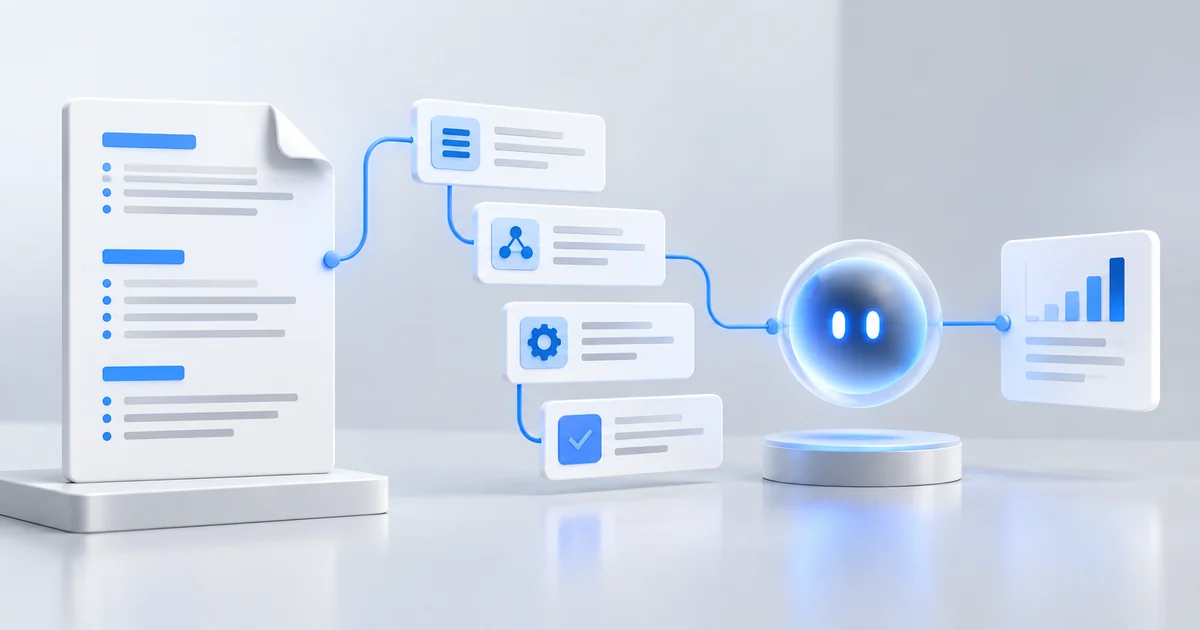
A SKILL.md file is a plain text file that tells an AI assistant how to do one specific job the way an experienced operator does it. It is markdown, a person can read it in two minutes, and an assistant like Claude, Cursor or Codex loads it at the moment the job comes up. If you have ever pasted the same 600 word prompt into a chat for the fifth time, a SKILL.md file is what that prompt becomes once it grows up.
The short definition
A skill is a named procedure. It has a title, a description that says when to use it, and a body that walks the model through the work in order. The name and description are the important part that most people skip. They are what lets the assistant recognize the moment: you type "my CPA jumped on the winning ad set" and the right procedure loads itself, because its description says that is exactly when it applies.
That is the difference between a file sitting in a folder and a skill that actually runs.
What is inside one
Every skill worth paying for has the same six parts, even when the author does not label them:
- A trigger. When should this load, in the words a user would actually type.
- The job. One outcome, stated narrowly. "Rotate creative before CPA spikes" beats "Facebook ads help".
- The steps, in order. What to pull first, what to compute, what to produce.
- Decision rules with numbers. Pause at what CPA. Scale at what ROAS and after how many purchases. The thresholds are the expertise.
- Guardrails. What never to do, and what to do when the data is missing or the numbers disagree.
- An output shape. A table, a checklist, a brief, a set of ad angles. Something you can act on without reformatting it.
Missing the fourth item is the most common failure. Instructions that say "analyze performance and optimize" produce a confident essay. Instructions that say "if a creative has spent 2x target CPA with zero purchases, kill it today, and if it is between 1x and 2x with at least one purchase, hold it 48 hours" produce a decision. See what belongs in a SKILL.md workflow for the structural version of this.
How it differs from a prompt
A prompt is one message in one conversation. A skill is a file with a life of its own.
- A prompt is typed again every time. A skill is loaded on demand, including in sessions you did not start.
- A prompt carries whatever you remembered in the moment. A skill carries the rules you wrote on your best day, including the edge case that cost you money in March.
- A prompt cannot be updated. A skill has versions, so when the platform changes its reporting window you fix one file instead of relearning the trick.
- A prompt is context. A skill is a procedure that decides what context to go get.
That last point matters more than it sounds. Good skills tell the assistant which tools to call, which numbers to pull, and in what order, before any writing happens.
How the file reaches your assistant
On Skillset, buying a skill does not hand you a download to file away and forget. You connect your assistant once, and purchased instructions load inside it when the job comes up. The mechanics are covered in how MCP brings a skill into your AI, and the setup is a one time paste of a connection into Claude, Cursor, Codex, Copilot or whichever tool you already use.
The practical upshot: you do not manage a folder of markdown files, and you do not go looking for the right one at the moment you need it. The description does the finding.
How to judge one before you buy
Read the description and the outline and ask four questions.
Does it name a job or a topic? "Facebook ads" is a topic. "Scale Facebook ads without guessing" is a job with a start and an end. Skim the skill catalog and you can tell the two apart in one sentence.
Are there numbers? Thresholds, windows, budgets, sample sizes. If every rule is qualitative, the author is describing a vibe.
Does it say what to do when things go wrong? Missing data, conflicting reports, an account with no purchase history yet. Real operators have a branch for these because they have hit them.
Is the output something you would send to someone? A brief, a matrix, a checklist. If the output is "insights", it is a blog post in disguise.
A short worked example
Say you test creative weekly. A prompt version of that job is "look at my ads and tell me what to make next". The skill version reads your last 14 days of spend, groups results by creative angle rather than by ad name, drops anything under a minimum spend so noise does not vote, ranks the surviving angles by cost per purchase, then writes briefs for three new variations of the top angle and one against the runner up. Same model, same account, completely different output, because the procedure did the thinking about what to compare.
That is also why skills travel. The person who wrote that procedure spent a year learning that grouping by angle beats grouping by ad. You get the grouping decision, not just the summary.
When you do not need one
One off work does not need a skill. Exploratory questions do not either. The test is repetition plus stakes: if you will do this job again within a month, and doing it badly costs money or a weekend, it belongs in a file. Everything else is a conversation.
If you are deciding between buying a skill and buying a course, the tradeoff is covered in AI skills vs online courses.
Where to start
Pick the job you repeat most, write down the five steps you actually take, then write down the three numbers you use to make calls inside it. That draft is already a skill. Run it, watch where the assistant guesses, and turn each guess into a rule. Two or three rounds later you have something worth handing to someone else, or selling.
Questions
Is a SKILL.md file the same as a custom GPT?
No. A custom GPT is a configured assistant you switch into. A SKILL.md file is a portable procedure that loads inside the assistant you already use, alongside your other skills, and can be versioned and updated on its own.
Do I need to be technical to use one?
No. Connecting your assistant once is a copy and paste step, and after that skills load by description when the job comes up. Writing one only requires being able to describe your own process in order.
How long should a SKILL.md file be?
Long enough to carry the steps, the thresholds and the failure cases, usually one to three pages. Padding hurts, because everything in the file competes for the model's attention.